Showing posts with label history. Show all posts

Sunday, April 17, 2011

Christmas spider

Up until a few years ago I had never heard of this Christmas folk tale.  Coming from the Ukraine and Germany this tale of a holiday spider helps us remember that even the smallest can make the holiday merry and bright.

Once upon a time, long ago, a gentle mother was busily cleaning the house for the most wonderful day of the year.... The day on which the Christ child came to bless the house. Not a speck of dust was left. Even the spiders had been banished from their cozy corner in the ceiling to avoid the housewife's busy cleaning. They finally fled to the farthest corner of the attic.


T'was the Christmas eve at last! The tree was decorated and waiting for the children to see it. But the poor spiders were frantic, for they could not see the tree, nor be present for the Christ child's visit. But the oldest and wisest spider suggested that perhaps they could peep through the crack in the door to see him. Silently they crept out of their attic, down the stairs, and across the floor to wait in the crack in the threshold. Suddenly, the door opened a wee bit and quickly the spiders scurried into the room. They must see the tree closely, since their eyes weren't accustomed to the brightness of the room... so the crept all over the tree, up and down, over every branch and twig and saw every one of the pretty things. At last they satisfied themselves completely of the Christmas tree beauty.

But alas!! Everywhere they went they had left their webs, and when the little Christ child came to bless the house he was dismayed. He loved the little spiders, for they were God's creatures too, but he knew the mother, who had trimmed the tree for the little children, wouldn't feel the same, so He touched the webs and they all turned to sparkling, shimmering, silver and gold!

Ever since that time, we have hung tinsel on our christmas trees, and according to the legend, it has been a custom to include a spider among the decorations on the tree.  Source
 
This is a great folk story to explain why we use tinsel on our trees.  Tinsel was first invented in Nuremberg around 1610. Tinsel was originally made from extruded strands of silver. Because silver tarnishes quickly, people began to substitute other shiny metals in the tinsel-making process. Before the 16th century, tinsel was used for adorning sculptures rather than Christmas trees. It was added to early Christmas trees to enhance the flickering of the candles on the tree. Tinsel was also used to represent the starry sky over a Nativity scene.
 
Metallic tinsel was fragile and costly, made mainly from fool's gold (pyrite), so it was used in small quantities. Only wealthy people would have been able to afford enough tinsel to cover their tree. By the early 20th century, advances in manufacturing made it possible to produce cheap aluminium-based tinsel. This led to most people being able to afford to add tinsel and tinsel garlands to their trees. In fact, during the 1950s, tinsel and tinsel garlands were so popular that they frequently were used more heavily than Christmas lights by many people. The one drawback of the aluminized paper used to create tinsel at this time was that it was flammable. Early Christmas tree lights were quite hot and could start fires, especially when the aluminized paper tinsel got near a hot Christmas tree bulb. Newer Christmas lights are cooler and do not pose as much of a fire hazard.  Source

I remember painstakingly taking each strand of tinsel out of the box and placing it on the tree branches as we decorated for the holiday.  Inevitably the static charge would build up and it would stick to our hands and clothes.  That's one thing I don't miss about those old style decorations.  You would end up finding stands of tinsel hiding behind the couch months later.  Or have it wrapped around the vaccuum brush when you did your post Christmas clean up.  Now we use ribbon as garland and some white berries for contrast.   Any way you look at it, tinsel and the legend of the Christmas spider makes every Christmas special.

Saturday, April 9, 2011

Figgy Duff

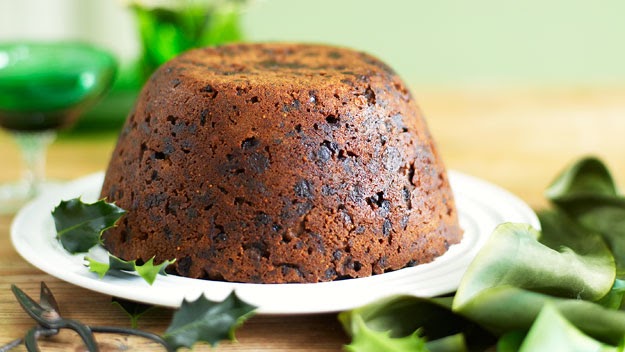
Originally coming from Newfoundland I wanted to share a little bit of my Christmas history.  This pudding is usually served on Christmas Day for supper, with the leftovers (if there are any) fried up for breakfast.  While it sounds like the name of a band or some sort of dance, figgy duff is actually a steamed, dense cake.  And despite the name, there are no figs in this traditional Newfoundland Christmas dessert, usually raisins.  For some reason, raisins are were called figs in many parts of the province.  Also, many people in England, of which many Newfoundlanders originated, called any type of dessert a "pudding" unlike today where a pudding conjures up memories of a creamy, custard-like dessert.  Closely resembling Spotted Dick, the pudding is boiled in a cloth bag or it can be steamed in a pudding mold. 

Here's how you make it:

Sift together:


2 cups flour, ½ cup sugar, 2 tsp baking powder


Add - 1 cup raisins and mix in.

Add 1/3 cup melted butter, ¾ cup milk, 2 tsp vanilla extract

Mix all together with a wooden spoon just until a soft dough is formed. Put dough into a pudding steamer or a wet heavy cotton pudding bag, tying the bag with a piece of butcher string but leaving about an inch of slack at the top to allow the pudding to expand. Boil for approximately 1 to 1 1/2 hours. This is most often done in the pot with the boiled root vegetables, cabbage and salt beef included in a Jiggs Dinner but can be done in a pot on its own as well.

Sunday, January 16, 2011

Snow

Well, it seems to have been snowing for a while.  It's funny how images of snow, sleigh rides, and getting outside into the crisp air brings a smile to our faces during Christmas.  But when the holiday season is over we get sick of it pretty fast.  In about a month or so it will start to warm up again and those below freezing temperatures will be a long forgotten memory.


Snow, ice and Christmas often go together, although why it should is a bit strange! There is no snow or ice in the Christmas story told in the Bible. However, snow does fall in Israel. Bethlehem and Jerusalem are on a range of hills that go north to south between the Mediterranean Sea and the Jordan valley. The top of these hills are about 1600 ft (500 m) high. The hills often have very cold weather from November to April and snow can often fall. So, although the Bible story may not have snow in it, Jesus may well have seen some snow in his life!

The reason that we think of snow and ice at Christmas is portably down to the Victorians! Although Christmas was taken over from the Pagan winter solstice festivals in Europe, it was the Victorians who gave us our 'traditional' Christmas in Europe and the U.S.A. At the start of the Victorian era, (1837) Britain was in a mini ice age that was from about 1550 to 1850. During this time, in London, a winter fair was held on the frozen River Thames!

One of the main reasons that the Victorians put Snow and Christmas together was the book 'A Christmas Carol' written in 1843 by Charles Dickens.

It tells the story of a mean old business man called Ebenezer Scrooge who hates Christmas. During the night of Christmas Eve, he is visited by three ghosts, one of Christmas Past, one of Christmas Present and one of Christmas yet to come. They show him how mean he really is. He realises that making friends is more important than making money. When he wakes up on Christmas Day, he is a changed man and give lots of money and presents away. (If you don't know the story, I recommend that you read the book or see a film of the story! A very famous film of it was made in 1951 [4 years after Britain had some of its heaviest snow of the 1900's], but my favourite version is the Muppet's Christmas Carol!!!)

When Charles Dickens was a child, Britain had very heavy snow falls around Christmas, so when he wrote 'A Christmas Carol' he put lots of snow and ice in it! He also put snow at Christmas in some of his other books like 'The Pickwick Papers'. Charles Dickens' books were very popular (and still are!) so when the Victorians read the books, they thought of snow and Christmas together!

Sunday, November 14, 2010

Christmas History: Jesus' Birth

We all know that the world celebrates the birth of Jesus on December 25.  That's the main reason it's called Christmas.  It's Christ's Mass.  But if you go back to scripture to find out why December 25 is the day we use, you might be a bit surprised with the answer.

Was Jesus born on December 25? There is no evidence for this date. So then, who decided that Jesus' birth would be celebrated on that date? The early Christian church did not celebrate Jesus' birth. It wasn't until A.D. 440 that the church officially proclaimed December 25 as the birth of Christ. This was not based on any religious evidence but on a pagan feast. Saturnalia was a tradition inherited by the Roman pagans from an earlier Babylonian priesthood. December 25 was used as a celebration of the birthday of the sun god. It was observed near the winter solstice.


The apostles in the Bible predicted that some Christians would adopt pagan beliefs to enable them to make their religion more palatable to the pagans around them. Therefore, some scholars think the church chose the date of this pagan celebration to interest them in Christianity. The pagans were already used to celebrating on this date.

The Bible itself tells us that December 25 is an unlikely date for His birth. Palestine is very cold in December. It was much too cold to ask everyone to travel to the city of their fathers to register for taxes. Also the shepherds were in the fields (Luke 2:8-12). Shepherds were not in the fields in the winter time. They are in the fields early in March until early October. This would place Jesus' birth in the spring or early fall. It is also known that Jesus lived for 33.5 years and died at the feast of the Passover, which is at Easter time. He must therefore have been born six months the other side of Easter - making the date around the September/October time frames.

Other evidence that December 25 is the wrong date for the birth of Jesus comes from early writings. Iranaeus, born about a century after Jesus, notes that Jesus was born in the 41st year of the reign of Augustus. Since Augustus began his reign in the autumn of 43 B.C., this appears to substantiate the birth of Jesus as the autumn of 2 B.C. Eusebius (A.D. 264-340), the "Father of Church History," ascribes it to the 42nd year of the reign of Augustus and the 28th from the subjection of Egypt on the death of Anthony and Cleopatra. The 42nd year of Augustus ran from the autumn of 2 B.C. to the autumn of 1 B.C. The subjugation of Egypt into the Roman Empire occurred in the autumn of 30 B.C. The 28th year extended from the autumn of 3 B.C. to the autumn of 2 B.C. The only date that would meet both of these constraints would be the autumn of 2 B.C.

John the Baptist also helps us determine that December 25 is not the birth of Jesus. Elizabeth, John's mother, was a cousin of Mary. John began his ministry in the 15th year of Tiberius Caesar. The minimum age for the ministry was 30. As Augustus died on August 19, A.D. 14, that was the accession year for Tiberius. If John was born on April 19-20, 2 B.C., his 30th birthday would have been April 19-20, A.D. 29, or the 15th year of Tiberius. This seems to confirm the 2 B.C. date, and, since John was 5 months older, this also confirms an autumn birth date for Jesus.

Another interesting fact comes from Elizabeth herself. She hid herself for 5 months and then the Angel Gabriel announced to Mary both Elizabeth's condition and that Mary would also bear a son who would be called Jesus. Mary went "with haste" to visit Elizabeth, who was then in the first week of her 6th month, or the 4th week of Dec., 3 B.C. If Jesus was born 280 days later it would place his birth on Sept. 29, 2 B.C. Some scholars interpret the 6 months to be in line with the Hebrew calendar or the August-September time frame. Since Mary's pregnancy commenced a little before the sixth month around July, Jesus would be born somewhere around March-June. But does it matter if Jesus was born on the spring, the fall, or on December 25? Does it matter, theologically, when Jesus was born? What do you think, does it matter what day we celebrate His birth?

source: http://www.allaboutjesuschrist.org/

Sunday, November 7, 2010

Christmas History: Caroling

Our church is having their Lessons and Carols service on December 12, and we've started rehearsing for it already.  This got me to thinking about where caroling comes from. 

Carols were first sung in Europe thousands of years ago, but these were not Christmas Carols. They were pagan songs, sung at the Winter Solstice celebrations as people danced round stone circles. The Winter Solstice is the shortest day of the year, usually taking place around the 22nd December. The word carol actually means dance or a song of praise and joy! Carols used to be written and sung during all four seasons, but only the tradition of singing them at Christmas has really survived!


Early Christians took over the pagan solstice celebrations for Christmas and gave people Christian songs to sing instead of pagan ones. In AD 129, a Roman Bishop said that a song called 'Angel's Hymn' should be sung at a Christmas service in Rome. Another famous early Christmas Hymn was written, in 760AD, by Comas of Jerusalem for the Greek Orthodox Church. Soon after this many composers all over Europe started to write carols. However, not many people liked them as they were all written and sung in Latin, a language that the normal people couldn't understand. By the time of the Middles Ages (the 1200s), most people had lost interest in celebrating Christmas altogether.


This was changed by St. Francis of Assisi when, in 1223, he started his Nativity Plays in Italy. The people in the plays sang songs or 'canticles' that told the story during the plays. Sometimes, the choruses of these new carols were in Latin; but normally they were all in a language that the people watching the play could understand and join in! The new carols spread to France, Spain, Germany and other European countries.


The earliest carol, like this, was written in 1410. Sadly only a very small fragment of it still exists. The carol was about Mary and Jesus meeting different people in Bethlehem. Most Carols from this time and the Elizabethan period are untrue stories, very loosely based on the Christmas story, about the holy family and were seen as entertaining rather than religious songs. They were usually sung in homes rather than in churches! Traveling singers or Minstrels started singing these carols and the words were changed for the local people wherever they were traveling. One carols that changed like this is 'I Saw Three Ships'.


When Oliver Cromwell and the Puritans came to power in England in 1647, the celebration of Christmas and singing carols was stopped. However, the carols survived as people still sang them in secret. Carols remained mainly unsung until Victorian times, when two men called William Sandys and Davis Gilbert collected lots of old Christmas music from villages in England.

Before carol singing in public became popular, there were sometimes official carol singers called 'Waits'. These were bands of people led by important local leaders (such as council leaders) who had the only power in the towns and villages to take money from the public (If others did this, they were sometimes charged as beggars!). They were called 'Waits' because they only sang on Christmas Eve (This was sometimes known as 'watchnight' or 'waitnight' because of the shepherds were watching their sheep when the angels appeared to them.), when the Christmas celebrations began.


Also, at this time, many orchestras and choirs were being set up in the cities of England and people wanted Christmas songs to sing, so carols once again became popular. Many new carols,such as 'Good King Wenceslas', were also written .

New carols services were created and became popular, as did the custom of singing carols in the streets. Both of these customs are still popular today! One of the most popular types of Carols services are Carols by Candlelight services. At this service, the church is only lit by candlelight and it feels very Christmassy! Carols by Candlelight services are held in countries all over the world.


Perhaps the most famous carol service, is the service of Nine Lessons and Carols from King's College in Cambridge, UK. This service takes place on Christmas Eve and is broadcast live on BBC Radio (and all over the world). In my house, we listen to it and it means Christmas has really started!! The Service was first performed in 1918 as a way of the college celebrating the end of the First World War. It is always started with a single choir boy singing a solo of the first verse of the Carol 'Once in Royal David's City'. Sing along to Once in Royal David's City! A service of Nine Lessons and Carols, has nine bible readings (or lessons!) that tell the Christmas story with one or two carols between each lesson. Sometimes you get carol services which are a combination of nine lessons and carols and carols by candlelight! So you have nine lessons and carols by candlelight!

Saturday, September 25, 2010

Christmas History: Ornaments

Christmas Ornaments History, Facts, and Origins

In the eleventh century, religious plays called "mystery plays" became popular throughout Europe. One of the most prevalent plays was the annual Christmas "Paradise Play" This play told of the Biblical account of Adam and Eve and the partaking of the forbidden fruit. The only prop on the stage was the "Paradise tree", a fir tree adorned with apples, which represented their sin. Later, wafers were added to the tree which stood for Christ's atoning sacrifice. Red and White flowers later adorned many of these trees. Red symbolized knowledge and the White flowers represented innocence. Many credit the common Christmas ornament colors of Red, Green and White to the Paradise Tree.

Christmas Ornaments and Christmas Tree Decorations - A Chronological History

The first account we have of a tree decorated with Christmas ornaments in a home dates from 1605 in Strasbourg, Germany. The use of Christmas ornaments spread in Germany with cookies, bread, nuts and the like serving as decorations. So many sweets decorated the German Christmas tree it was nicknamed the "sugar tree." Small gifts also made their way to the branches of the Christmas tree.

German immigrants brought their Christmas tree decorating habits to America, where the tradition spread.

The Christmas ornaments that caught the public's eye were the glass-blown ornaments hand-crafted in Lauscha, Germany. Besides their visual appeal, their lightweight design may have been equally appealing. With all the Christmas candles and the food, wood and metal ornaments, Christmas trees became rather heavy. The light glass-blown ornaments may have been a welcome replacement for some of the heavier ornaments.

There are several legends behind using tinsel to decorate the Christmas tree. The primary one tells of a woman whose husband had died. She needed to bring up a large family of children herself. She worked hard and was determined to make a happy time for them at Christmas. She prepared a Christmas tree to surprise them on Christmas Day. Unfortunately spiders visited the tree, and crawled from branch to branch, making webs all over it. The Christ Child saw the tree and knew she would be devastated to find this on Christmas morning. He changed the spiders' webs to shining silver. 

In the 1860s and 70s, the first commercial Christmas tree ornaments began to emerge. Some of these commercial Christmas ornaments were crafted out of embossed and painted cardboard. These were Dresden ornaments, named for the German city where they were produced. In Germany in the 1600's, Christmas Trees were decorated with colored paper, small toys, food, and sometimes candles.

Later, tinsel, silver wire ornaments, candles and small beads became common. The custom was to have several small trees on tables, one for each family member, with their gifts stacked on the table under the tree.

Electric Christmas tree lights were first used just 3 years after Thomas Edison had his first public demonstration of electric lights in 1879. The early Christmas tree lights were handmade and rather expensive.

Christmas Ornaments in the 1900's

In the 1900's, popular decorations included strings of popcorn, homemade cards, pictures, cotton to look like snow, candy, and eventually glass balls and figurines. Some people used candles, but they often caused devastating fires. 

In the 1930's, common Christmas tree decorations included bells, balls, and tinsel, and with a beautiful golden haired angel at the top. Commercial Christmas ornaments took off in America when F.W. Woolworth, of five-and-dime store fame reluctantly began selling German glass ornaments and they sold out in two days. That convinced him and he began his buying trips to Germany. Translucent plastic shapes, honeycomb paper angels, and glow-in-the-dark icicles became popular items.

Not until WWII did an American company succeed in manufacturing Christmas ornaments. Using a machine designed to make lightbulbs, the Corning Glass company was able to produce more than 2,000 Christmas ornaments a minute.

The mid-1960's saw another major change. The world was changing and modernist ideas were everywhere. Silver aluminum artificial trees were so popular that they were imported from America throughout the world. Colored lights placed below the tree made decorations unnecessary.

In the 1970's, America made a return to Victorian nostalgia and the trees had a refreshing new look. Some American companies specialized in making antique replicas, but others found the original makers in Europe to recreate wonderful glass ornaments and real silver tinsels.
Real Christmas trees were popular. However, several manufacturers starting creating artificial trees that looked real. Many homemakers preferred the convenience of a real looking artificial Christmas tree. If your room was big enough, you could have a 14-foot artificial spruce right in your living room-with no dropped needles! The new pine scented sprays claimed to give your artificial Christmas tree that "real tree smell"! 

In the 1990's, "theme trees" gain in popularity. For example, popular Christmas ornaments helped complete the decorations for the "Starry Night tree", the "Twilight tree", and even pop culture trees. 

In the 2000's, personalized ornaments lead in popularity.
Today, you can find Christmas ornaments in nearly every size, color, and shape imaginable. From handmade ornaments to limited edition and collector's edition Christmas ornaments, thousands of styles exist to decorate your Christmas tree.

Sunday, September 12, 2010

Christmas History: Old Christmas Day

Until the time of Julius Caesar the Roman year was organized round the phases of the moon. For many reasons this was hopelessly inaccurate so, on the advice of his astronomers, Julius instituted a calendar centered round the sun. It was decreed that one year was to consist of three hundred and sixty-five and a quarter days, divided into twelve months; the month of Quirinus was renamed 'July' to commemorate the Julian reform. Unfortunately, despite the introduction of leap years, the Julian calendar overestimated the length of the year by eleven minutes fifteen seconds, which comes to one day every on hundred and twenty-eight years. By the sixteenth century the calendar was ten days out. In 1582 reforms instituted by Pope Gregory XIII lopped the eleven minutes fifteen seconds off the length of a year and deleted the spare ten days. This new Gregorian calendar was adopted throughout Catholic Europe.


Protestant Europe was not going to be told what day it was by the Pope, so it kept to the old Julian calendar. This meant that London was a full ten days ahead of Paris. The English also kept the 25th of March as New Year's Day rather than the 1st of January. By the time England came round to adopting the Gregorian calendar, in the middle of the eighteenth century, England was eleven days ahead of the Continent.

A Calendar Act was passed in 1751 which stated that in order to bring England into line, the day following the 2nd of September 1752 was to be called the 14th, rather than the 3rd of September. Unfortunately, many people were not able to understand this simple manoeuvre and thought that the government had stolen eleven days of their lives. In some parts there were riots and shouts of 'give us back our eleven days!'

Before the calendar was reformed, England celebrated Christmas on the equivalent of the 6th of January by our modern, Gregorian reckoning. That is why in some parts of Great Britain people still call the 6th of January, Old Christmas Day.

Thursday, September 2, 2010

Gingerbread House

What would the holidays be without the smell of gingerbread wafting through the air?  Gingerbread has been around since the early Christian times, when the ancient Romans baked it portable ovens.  As early as the 1500s, inventive bakers began using it as a decorative building material.  The fragrant pastry became popular in early American cooking because it was inexpensive to make and it could survive the unpredicability of wood and coal fired ovens.

Gingerbread houses became popular in Germany.  Enterprising parents created a house similar to the witch's house in the Grimm's tale Hansel and Gretel.  The hard gingerbread is made in decorative shapes, which are then further decorated with sweets and icing. The tradition of cutting gingerbread into shapes takes many other forms, and exists in many countries, a well known example being the gingerbread man. Traditionally, these were dunked in port wine.  Early German settlers brought this lebkuchenhaeusle - gingerbread house - tradition to the Americas.

Nowadays, gingerbread houses can be as simple or as elaborate as you want it to be.  You can take the time to make your own, or simply buy a store bought kit.  Many pastry chefs show off their talents with gingerbread house competitions throughout the country; showing their amazing techniques and innovations using this versatile confection.

There are many sites out there to help you become inspired with your creation.  Ranging from the simple 8x8 design to ones more complicated, you'll find something for all talent levels.  Try out such sites as Gingerbread Lane or Ultimate Gingerbread for some ideas of where to start.  Or if you have the means, get the house already made for you from a Gingerbread Construction Company.  Luckily, the dough is very tough and practically keeps forever.  You can leave out your house for the whole Christmas season without worrying about decay.

Whatever you choose to do, make it fun for the family.  Get the children involved in decorating the house.  Then you can show off your creation to all your friends during the holiday season.

Happy Holidays!

Tuesday, August 31, 2010

Christmas History: Medieval Christmas

The next few hundred years of Christmas didn't change much.  Mostly on account that people were just trying to survive.  The average person was lucky to live to their thirties with so many diseases, bad hygene and poor diet.  That being said, people still took time to celebrate the season each year.  Christmas is Medieval England was very different to Christmas now. The Church ensured that Christmas was a true religious holiday. Celebrations were for the birth of Christ as opposed to simply peasants enjoying themselves.

The first recorded use of the word "Christmas" was in 1038 when a book from Saxon England used the words "Cristes Maesse" in it.

Also of note for Medieval England was the fact that William the Conqueror had himself crowned king of England on Christmas Day 1066. Those noble men allowed inside Westminster Abbey cheered so loudly when the crowning ceremony was taking place that the guards outside thought something was happening to their master inside the abbey. They rushed inside, attacked people and houses near to Westminster Abbey were burned down.
However, some of the problems experienced at Christmas then have had a knock-on effect for us. For example, carol singers going from house to house now is as a result of carols being banned within churches in Medieval times. Carol singers in Medieval times took the word "carol" literally - it means to sing and dance in a circle. So many Xmas services were spoiled by carol signers doing just this, that the Church at the time banned them and ordered the carol singers into the street.

The Christmas crib originated in Medieval times but in Medieval Italy. In 1223, Saint Francis of Assisi is said to have used a crib to explain to the local people of Assisi the Christmas story. It seems that the part played by animals in the Christmas story also comes from the early 13th century even if the Bible does not mention them.

December 28th is a day children may not have enjoyed in Medieval times. December 28th is "Holy Innocents Day" or "Childermass Day". This is the day when King Herod ordered that all children under two years of age be killed. In some European towns it was the custom for a boy to be given charge of a town for one day after being made a bishop for just December 28th. In Medieval England, children were reminded of Herod’s cruelty by being beaten. December 28th was seen by many then as a day of bad luck. No-one would get married on that day; no-one would start a building on that day and Edward IV refused to be crowned on that day.

What was eaten on Christmas Day? Certainly not turkey. Turkeys naturally come from America and only got to Europe after the discovery of that continent in the late 15th century. So turkey would not have been on the Christmas menu of anybody in England. The rich would have eaten goose and, with the king’s permission, swan. If they could be caught, woodcock would also be eaten. To make a roast bird look even more tasty, medieval cooks used to cover the cooking bird with butter and saffron plant. This would give the cooked bird a golden colour by the time it was served. However, if the poor could afford it, the Church had a fixed price of 7 pence for a ready cooked goose. An uncooked goose would cost 6 pence - about a day’s wages.

Venison from deer would also be on the menu. It has also given us a famous saying !! The poor would not be allowed to eat the best parts of a deer. However, in keeping with the spirit of Christmas, a decent lord might let the poor have what was left of the deer. These parts were known as the deer's ‘umbles’. These were the heart, liver, tongue, feet, ears and brains. Mixed with whatever else a cook could get, they were made into a pie. Therefore, the poor would eat ‘umble pie’. Nowadays, if you have taken a tumble in life and have to live a standard of life you would not usually be used to, it is said that you are having to eat ‘humble pie’.

Mince pies are a tradition now for Christmas. In Medieval England a large mince pie was always baked. However, they were filled with all sorts of shredded meat along with spices and fruit. This recipe only changed in Victorian times when the shredded meat was left out.
It was also believed that if you made a wish with the first bite of your first mince pie, your  wish would come true. If you also refused the first mince pie someone offered you over Christmas, you would then suffer bad luck.

Christmas puddings in Medieval England were spicy porridge and known as "frumenty". This was considered a real treat. It was made of thick porridge (or boiled wheat). Currants and dried fruit were stirred in. The yolks of eggs were also added and, if available, spices such as cinnamon and nutmeg. The mixture was left to cool and set before being served.
A less than Christian practice at this time and found only really in the countryside was the practice of killing a wild boar, cutting off its head, and offering it to the goddess of farming so that you would have a good crop in the following year.

Christmas Day was also a "quarter day". This meant that the poor had to pay their rent on this day!

"Mumming" was also practiced at Christmas. This was where actors performed plays and dances in villages or castles. Mystery plays were also performed in which the story of Christ was told. King Herod would be in a mystery play and he would be the equivalent of a ‘baddie’ in a modern pantomime.

Source: http://www.historylearningsite.co.uk/medieval_xmas.htm

Thursday, August 26, 2010

There's a light......

We can't think of the holidays without having some conversation about lights.  We have them on our trees, on our homes, and on our yards.  Some are modest and some are over the top.  Some are set with music, or just blink on and off.  Whatever your tradition, lights are part of the holidays.

The first Christmas lights that resembled what you see on trees today were first used in 1882. Edward Johnson, an associate of Thomas Edison, wound 80 red, white, and blue bulbs around his Christmas tree. The bulbs were hand wired together, much like how you would string beads on thread to make a necklace.


In 1895, President Grover Cleveland added electric Christmas lights to the tree in the White House. This important moment in Christmas lights history created widespread interest in a newer method of holiday decorating. Thomas Edison began offering hand-blown bulbs for Christmas trees through General Electric and many large businesses began using brightly lit trees as a strategy for attracting customers during the holiday shopping season. When the public saw these trees, they sometimes referred to the Christmas lights as either "fairy lights" or "twinkle lights."

In the early 1900s, it became fashionable for members of high society to throw Christmas tree lighting parties. These elaborate parties were planned for many months and cost a considerable amount of money. While the average worker only made 22 cents per hour at this time, the first Christmas lights cost $12 for a set of 24 lights. In addition, the process of attaching the individual lights to the tree required skills that most people did not possess. The services of a professional wireman were typically required before the party could begin. 
In 1908, the first battery-operated Christmas tree lights became available after Ralph Morris came up with the idea of pulling the lights from an old telephone switchboard for use on a Christmas tree.

By most accounts, Albert Sadacca deserves credit for making Christmas tree lights widely available to the public. In 1917, after learning of a fire caused by a poor family who decorated their tree with lit candles because they couldn't afford modern Christmas lights, the 15-year old entrepreneur convinced his parents to use the bulbs from their business making novelty bird cage lights to create safe and affordable strings of Christmas lights. The idea got off to a slow start, but quickly picked up steam once they decided to paint the bulbs different colors instead of selling plain white lights.

Later, Albert Sadacca and his brothers Henri and Leon began NOMA Electric Company to manufacture and distribute Christmas lights. Until the 1960s, their company was the largest supplier of Christmas lights in the world. 


I remember those simple incandesant lights that everyone had when I was growing up.  If you were lucky you had the string of lights that, if one burnt out, the whole string of lights didn't do dark.  That chore was left to me or my brother.  Going from one light to the next, unscrewing the light, replacing it with a new one to see if the strand lit up, and then progressing to the next one, and so on.   Regardless of the work we thought was tedious, I still love it when the house is dark on Christmas Eve, but the tree's lights are on.  There's that stillness in the night, coupled with the gentle glow of the lights that makes the night a little more special.
Nowadays the trend is using LED, or light emitting diodes, lights for your Christmas lights.  They use considerably less energy, last longer, and are harder to break.   On the downside though, once one lights goes, you have to replace the whole string.  Also, not all lights have the same hue.  If you want to just have one colour on your tree, such as white, you should stick to using lights from the same company.  And check the box to make sure that it's the same type of white.  Some are more "natural" light and some of softer.  I learned that the hard way.  Regardless of what type of light you choose, having the gentle glow of the lights on the tree, or adorning the houses on your street, help you celebrate the holidays with a little more warmth.  Happy Holidays.

Thursday, August 19, 2010

Nod to the Nog

What's Christmas without the perennial favourite drink: eggnog?  To get your full serving of this creamy beverage check out Eggnogaholic.  Made by one of the moderator at one of my favourite sites, Talk Christmas, Eggnogaholic features tons of infomation about this drink.  Plus many different recipes to make your own, add it to other recipes, or just to replicate the flavours within a certain dish.  Click over to try out a few eggnog jokes on your friends.

Many believe that eggnog is a tradition that was brought to America from Europe. This is partially true. Eggnog is related to various milk and wine punches that had been concocted long ago in the "Old World". However, in America a new twist was put on the theme. Rum was used in the place of wine. In Colonial America, rum was commonly called "grog", so the name eggnog is likely derived from the very descriptive term for this drink, "egg-and-grog", which corrupted to egg'n'grog and soon to eggnog. At least this is one version...

Other experts would have it that the "nog" of eggnog comes from the word "noggin". A noggin was a small, wooden, carved mug. It was used to serve drinks at table in taverns (while drinks beside the fire were served in tankards). It is thought that eggnog started out as a mixture of Spanish "Sherry" and milk. The English called this concoction "Dry sack posset". It is very easy to see how an egg drink in a noggin could become eggnog.
The true story might be a mixture of the two and eggnog was originally called "egg and grog in a noggin". This was a term that required shortening if ever there was one.
With it's European roots and the availability of the ingredients, eggnog soon became a popular wintertime drink throughout Colonial America. It had much to recomend it; it was rich, spicy, and alcoholic.
In the 1820's Pierce Egan, a period author, wrote a book called "Life of London: or Days and Nights of Jerry Hawthorne and His Elegant Friend Corinthina Tom". To publicize his work Mr. Egan made up a variation of eggnog he called "Tom and Jerry". It added 1/2 oz of brandy to the basic recipe (fortifying it considerably and adding further to its popularity).

Eggnog, in the 1800s was nearly always made in large quantities and nearly always used as a social drink. It was commonly served at holiday parties and it was noted by an English visitor in 1866, "Christmas is not properly observed unless you brew egg nogg for all comers; everybody calls on everybody else; and each call is celebrated by a solemn egg-nogging...It is made cold and is drunk cold and is to be commended."

Of course, Christmas was not the only day upon which eggnog was popular. In Baltimore it was a tradition for young men to call upon all of their friends on New years day. At each of many homes the strapping fellows were offered a cup of eggnog, and so as they went they became more and more inebriated. It was quite a feat to actually finish one's rounds.

America's first President, George Washington, was quite a fan of eggnog and devised his own recipe that included rye whiskey, rum and sherry. It was reputed to be a stiff drink that only the most courageous were willing to try.

Eggnog is still a popular drink during the holidays, and its social character remains. It is hard to imagine a Christmas without a cup of the "nog" to spice up the atmosphere and lend merriment and joy to the procedings.

Source: www.indepthinfo.com/eggnog/history.shtml

Monday, August 9, 2010

Christmas History: Advent

With the Christian holiday established, people wanted to be prepared for the upcoming celebrations. Advent, taken from the latin adventus ("coming") is now the four week period prior to Christmas Day observed by many Christmas throughout the world. It is a time which believers are to undergo a spiritual cleansing and sometimes ritual fasting in preparation for the feast of Nativity, or Christmas.

Although legend holds that advent was attribited to the Apostle Peter, the exact date of its inception is not precisely known. There are writings vaguely referring to advent ranging from the fourth to sixth centuries. Pope St. Gregory the Great (590-604) only included a sermon on the second Sunday of Advent, and in 650 Advent was expanded to five Sundays before Christmas. This was changed again to four Sundays by Pope St. Gregory VII in the eleventh century.


Advent focuses on the four great comings of Christ: His coming of the flesh, His coming into the hearts of believers, His coming at the hour of death, and His coming at the final judgement. In some traditions there are four colours associated with the Advent season: dark blue, purple, rose or pink, and light blue. Also, candles representing each Sunday of Advent are lit, one per Sunday up to Christmas Day. On Christmas Day a large red candle is added, representing Christ.

One variation is to light one candle with the numbers one through twenty-five stamped on the side. The candle is lit on December 1 and allowed to burn down to the next number. It is then extinguished and relit the next day. This is the precusor to the advent calendar for children. Traditionally, the advent calendar had little flaps, each one contained a bible verse for the child to read to remind him or her of piety and obediance. Now, a child can find a small toy, candy, or money in the calendar.

Whatever your tradition, Advent marks the beginning of the Christmas season for Christians, heralding the coming of Christ. It is filled with anticipation and preparation. Use the season to personally reflect on what makes Christmas special to you. Then on Christmas Day you can celebrate!

Happy Holidays.

Source: The Christmas Encyclopedia by William D. Crump

Saturday, July 17, 2010

Christmas History: Christianity, the Mystery Cult

There was a new religion gaining ranks in the Roman world: Christianity. This mystery cult had the Romans up at arms. Mystery in a sense that its operation was only available to iniates. Christianity in as much as participation in it's religious life is open only to the baptised is a mystery religion. Worship just one god? Defy the emperor? People following the Christian faith, at that time, were being persecuted by the Emperor and singled out for punishment and torture. Christians had to be secretive and in seclusion. For any religion to gain popularity you need participants. A problem was encountered during the conversion to Christianity, however. No matter how good the new religion sounded to the Roman peoples, they were used to their old ways and unique lifestyle. More importantly, they knew how the Gods reacted to these situations, and they trusted Them. There was no reason to switch sides, so to speak, to a god they didn't know, or a religion they weren't familar with.

Taking that into consideration, Christians thought of a plan to make the new converted feel more at ease. They built churches on old worship sites. Their reasoning: people knew the sites, felt comfortable worshipping there and would continue to frequent them, with a building there or not. They incorporated Pagan symbols within the church decor, and added some revised customs to their rituals. To help smooth matters further, they changed the names to some of the deities, called them saints, and added them to the new Christian pantheon.

Sounds easy, right? Well, not really. The Romans were a little upset about all the changes that were happening. They thought that the Christians were making fun of their gods. As a result, most Christians went into hiding for a little while until they could figure out what to do.

So, time passes and around the fourth century, the Christians had a revelation. Unlike other previous religions, Christianity focused on the workings on their god: Jesus, and his death and resurrection. Not much emphasis was placed on his birth. This presented a problem. Because the birth-death-rebirth cycle had been a major part of the Pagan belief system, ignoring the birth aspect became problematic.

Of course, to have a birth you need a woman. Not focusing on the birth of Jesus meant there was no woman, no mother. In Pagan religions there were many goddesses. The Christians needed a goddess. This goddess couldn't been anyone. They needed someone strong and powerful. Deciding on Mary, the mother of Jesus, the early Christians now placed more focus on the birth of their god and Mary became the "Mother of God."

Then came the question of when Jesus was born. The Christians set his birthday on December 25. This date fell in the middle of the winter holidays, and because some Pagans celebrated other festivals around that time anyway, the Christians believed this festival would be relatively unnoticed. They called this festival the "Birth of the Son" and because "son" and "sun" were pronounced the same, the Pagans would think it was just another addition to their festival. Everyone was happy and Christmas was born unto the world!

Source: The History of Yule: How it all began by Dorothy Morrison

Tuesday, July 13, 2010

Christmas in July

As I'm going to be away on the 25 of July, I thought I would introduce this a little early. Christmas in July is an event that has been going on for a number of years now and there are many stories about its origin. I've done a little research and found some plausible explanations for this semi-holiday. Here are some ideas:

In Western cultureChristmas occurs in December. Christmas is a Christian holy day that commemorates the birth of Jesus and is, in general, a time of gift-giving and holiday cheer. Christmas in July celebrations may be held in July to provide a second joyful celebration in the year.In the southern hemisphere, Christmas in July is the name given to social events with a winter Christmas theme, as July is generally the coldest month of the year.In the northern hemisphere during the summer months the weather becomes increasingly warm and many people crave the atmosphere of cooler temperatures, gift giving and holiday spirit. To satisfy this, some people throw parties during the month of July that mimic the holiday of Christmas. The features of Christmas in July include Santa Claus,ice cream and other cold foods and gifts. Nightclubs often host parties open to the public.

In many western countries, July has a minor number of marketing opportunities. In the United States and Canada, there are no national holidays between the first week of July (Canada Day on July 1 in Canada and the Fourth of July in the United States) and Labor day, leaving two months with no holidays. Some provinces in Canada have a civic holiday in August, but those holidays are not ones where gifts are exchanged between loved ones. Therefore, to justify sales, shops (such as Leon's in Canada) will sometimes announce a "Christmas in July" sale.

Scandinavian languages such as Swedish, Norwegian and Danish translate the word Christmas as Jul (literally, Yule), which happens to be the abbreviation for July in English. When you translate "Christmas in July" to Swedish you get "Jul i Juli".

Werther, an 1892 opera with libretto by Édouard Blau, Paul Milliet, and Georges Hartmann, had an English translation published in 1894 by Elizabeth Beall Ginty. In the story, a group of children rehearses a Christmas song in July, to which a character responds, "When you sing Christmas in July, you rush the season." It is a translation of the French, "vouz chantez Noël en juillet... c'est s'y prendre à l'avance." This opera is based on Goethe's The Sorrows of Young Werther. Christmas features in the book, but July does not.

The earliest known occasion to make the phrase Christmas in July literal was in July 1933 at Camp Keystone, a girl's summer camp in North Carolina, which celebrated with a Christmas tree, gifts, and a visit by Santa Claus. In 1935, the National Recreation Association's journal Recreation described what a Christmas in July was like at a girl's camp, writing that "all mystery and wonder surround this annual event."

The term, if not the exact concept, was given national attention with the release of the movie comedy Christmas in July in 1940, written and directed by Preston Sturges. In the story, a man is fooled into believing he has won $25,000 in an advertising slogan contest. He buys presents for family, friends and neighbors, and proposes marriage to his girlfriend.

In 1942, the Calvary Baptist Church in Washington, D.C., celebrated Christmas in July with carols and the sermon "Christmas Presents in July". They repeated it in 1943, with a Christmas tree covered with donations. The pastor explained that the special service was patterned after a program held each summer at his former church in Philadelphia, when the congregation would present Christmas gifts early to give ample time for their distribution to missions worldwide. It became an annual event, and in 1946 the service began to be broadcast over local radio.

The U.S. Post Office and U.S. Army and Navy officials, in conjunction with the American advertising and greeting card industries, threw a Christmas in July luncheon in New York in 1944 to promote an Early Christmas Mailing Campaign for service men and women overseas during World War II. The luncheon was repeated in 1945.

American advertisers began using "Christmas in July" themes in print for summertime sales as early as 1950.

From empirical observation in the Midwest of the United States, many times the birthdays of "Christmas kids" (children born around Christmas) are celebrated in July, perhaps to avoid doubling up on gifts from birthdays and Christmas .One thing I've notice as well. During the summer months most television series are in reruns. July seems to be the time the Christmas episodes air, given it's about 8 weeks (or so) after the beginning of the season. That's always a pleasant surprise for me. Regardless of the show I'll watch a Christmas episode.

Regardless of your traditions, celebration the season knowing that the more "traditional" season of Christmas is less than five months away. Happy Holidays!

Source: Wikipedia


Saturday, July 10, 2010

Christmas History: Romans and Greeks

As we continue eastward from our journey, from Egypt and Mesopotamia, we encounter the Romans and the Greeks. Word of the sun-worshipping festivals travels east. In Greece, Zeus defeats his father, Kronos, and the Titans, during the Greek version of Sacaea. But this isn't the main reason for the festivities. There are mischeivous imps, called Kallikantzaroi, roaming the land wreaking havoc on the twelve days of the Sacaea. These imps had a reputation of stealing souls, especially the ones of newly born children. Newborns were wrapped with garlic bundles, and a large log was kept burning for the duration of the festival to keep the imps at bay. The uninvited festive guests are said to sneak into homes through the chimney or, more boldly, by using the front door. And, surprise surprise, Greek families are keen to ward off the gaggles of goblin louts. Some use the legendary precaution of a black-handled knife. Others swear by hanging the lower jaw of a pig behind the front door or inside the chimney. Hanging a tangled strand of flax on the front door tends to flummox the dim-witted Kallikantzaroi, who pause to count the threads, a lengthy task which keeps them busy until sunrise.

Finally, with the Romans. Some Romans followed a sun worshipping religion called Mithraism, after the god Mithras. They combined most of the traditions of their predecessors and added a few new things. First was to adopt the Roman name for Zeus: Jupiter and his father Kronos, became Saturn. To honour Saturn, the festival happening around the winter solistice was called Saturnalia. The festival began at the Romans' temple of Saturn with a ceremony to remove the chain which bound the feet of the god all year long. During this week of festivities all of Rome was practically on holiday. Schools were dismissed and businesses were closed. The Romans decorated their homes with laurel boughs and lit candles to chase away evil spirits. Gifts were exchanged and elaborate parties ensued. The Romans knew how to throw a party and this was the biggest one of the year. As the sun gained power and the days became longer Jupiter's power was regained and Saturn's feet became bound again. The parties died down and things went back to normal. The mystery religion of Mithras only started around the first century C.E., just at the same time another religion was gaining propularity: Christianity.

Next time: Christianity's beginnings

Source: Greek Goblins Run Riot Over Christmas by Danylo Hawaleshka and Yule: A Celebration of Light and Warmth by Dorothy Morrison

Friday, July 2, 2010

Christmas History

While most of us know about the Christian part of the holiday, what about the other contributions have been made to the holiday over the years. I want to talk about the history of this great and wonderous holiday going back centuries before the birth of Christ. We all know that Christmas is a amalgamation of many different traditions, religious and secular. Each part of this history lesson I will try to enlighten you about a specific contribution to the holiday. And don't get me wrong, I'm not an expert, just an enthusiast. The knowledge I've compiled comes from many sources and many media. I will even go so far as to say that I can't guarantee that some of it will even be true. I will try to back up history with sources and reference material if possible, for verification.

History of Christmas: Before Christ


The beginning of winter has long been a time of celebration around the world. Centuries before the arrival of the man called Jesus, early Europeans celebrated light and birth in the darkest days of winter. Many peoples rejoiced during the winter solstice, when the worst of the winter was behind them and they could look forward to longer days and extended hours of sunlight. In Scandinavia, the Norse celebrated Yule from December 21, the winter solstice, through January. In recognition of the return of the sun, fathers and sons would bring home large logs, which they would set on fire. The people would feast until the log burned out, which could take as many as 12 days. The Norse believed that each spark from the fire represented a new pig or calf that would be born during the coming year.

The end of December was a perfect time for celebration in most areas of Europe. At that time of year, most cattle were slaughtered so they would not have to be fed during the winter. For many, it was the only time of year when they had a supply of fresh meat. In addition, most wine and beer made during the year was finally fermented and ready for drinking.

In Egypt, there was the celebration of the rebirth of Horus, the sun god. Because the Egyptians honoured Horus with a twelve month calendar, the festival lasted twelve days with each day symbolizing one month. Buildings were decorated with all sorts of greenery, such a palm branches. Each branch had twelve fronds, making it a small calendar. This was an ideal representation of the birth, death, rebirth cycle of the Sun.

Word of this festival traveled to Egypt's neighbors, the Babylonians, in Mesopotamia. The believed that these rituals were the heart of the Egyptians prosperity and they quickly adopted some similar festivities. Called Zagmuk, this festival incorporated their sun/creator god, Marduk. They believed that Marduk created the world, and made it one of order and peace. This wasn't easy though, to create the world Marduk had to fight the monsters of chaos.

Each year, as the days became shorted and the nights cooler, the monsters regained their strength and challenged Marduk's reign. This battle took place around the dates of the winter solstice, December 21 in our calendar. The Zagmuk festival started five days before the solstice and lasted six days after, with the peak of the festival falling on the day of the solstice itself. On the seventh day after the solstice, the Sun stayed longer in the sky, a sign that Marduk was on his way to victory. This resulted in parades and parties, and the occasional exchange of gifts. The world was renewed for another year and all was right with the Babylonian people.

Next time: Romans and Greeks

Source: thehistoryofchristmas.com and Yule: A Celebration of Light and Warmth by Dorothy Morrison